
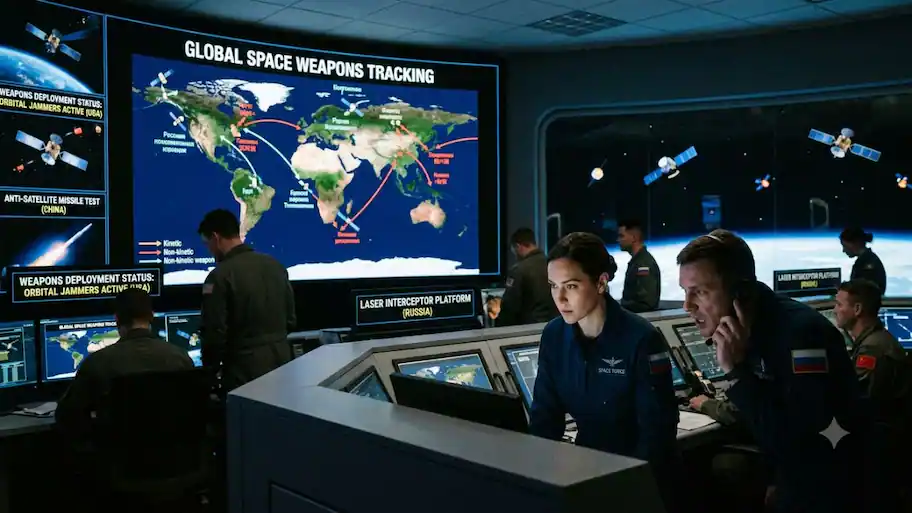
New Delhi: The United States has publicly acknowledged that it has deployed weapons in space, but Washington has not disclosed what system was sent into orbit or when the deployment took place. The admission comes with the United States, China and Russia building military capabilities that can protect their satellites and interfere with those of other countries.
US Air Force Secretary Troy Meink said on Monday (September 14) at an Air and Space Forces Association event in Maryland that the United States now has weapons capable of protecting joint forces from hostile actions in space. The US Space Force was created in 2019 and is the newest branch of the US military. In February this year, reports said two Russian satellites had intercepted communications from at least 12 European satellites after the beginning of the war in Ukraine. Washington also accused Moscow in 2024 of launching a satellite that could potentially attack other satellites. Moscow carried out only 17 launches in 2025. The number was below its annual average of more than 26 launches between 1995 and 2015. The country has also deployed Peresvet laser weapons at five strategic missile divisions since 2018, according to the fact sheet. The United States estimates that Russia could deploy more powerful lasers by 2030. It completed 37 launches by June this year, taking the number of its payloads in orbit to 1,506. It has set a target of 140 launches for 2026, which would be 52 per cent more than last year. US defence intelligence agencies estimate that China wants to deploy ASAT weapons capable of reaching geosynchronous orbit (GEO) at an altitude of around 36,000 km. Beijing launched a ballistic object in 2013 that reached a maximum altitude of around 30,000 km. The 1967 Outer Space Treaty sets rules for military activity in space. It came into force on October 10, 1967.
Control of space has therefore become an important part of modern defence planning. Because of limited funding, international isolation and social problems, the assessment further says Russia’s space technology has declined. Because disabling satellites can affect communication, surveillance and navigation, these capabilities have become an important part of military planning. The United States, Russia and China have therefore continued developing systems that can interfere with or target satellites.
He said the systems placed in orbit are needed to protect the US military from possible attacks and to ensure that American forces can operate freely in space. Meink said “flight-ready hardware” is now available for space-based interceptors, which are expected to form an important part of Golden Dome. It also has a role in what the military calls “space control”. The US Space Force says these capabilities can be used for both defence and attack. Russia views space as a battlefield and considers its control an important factor in future wars, according to a US Space Force fact sheet. The fact sheet also says Moscow is developing an anti-satellite (ASAT) capability involving a new satellite capable of carrying nuclear weapons. The US Space Force says Beijing is pursuing these systems as part of its military modernisation strategy. The US fact sheet also says China has deployed inspection and repair systems that could potentially be used as weapons. “Counterspace” capabilities refer to military systems that can disrupt, damage or destroy another country’s space-based systems.
The development comes against the military competition among the three major space powers. Satellites support military communication, surveillance and navigation. He did not disclose the type of weapon, its capabilities or the date of its deployment. The admission comes during the Trump administration’s efforts to develop space-based capabilities for its proposed ‘Golden Dome’ missile defence system. The proposed system is aimed at protecting the United States from missiles and other threats coming through the air. Some space security experts have expressed unease over the US announcement. They fear the deployment could encourage other countries to place more weapons in orbit. The Financial Times quoted an expert from the Secure World Foundation who suggested that the US system could be a space-based jammer. One reason behind that assessment is US policy against actions that could create large amounts of debris in space. A weapon that physically destroys another satellite can produce debris, creating additional risks for other satellites. Its main responsibility is protecting American assets in space, including hundreds of satellites used for communication and surveillance. This involves challenging the space capabilities of other countries and gaining control over space operations when required. Such capabilities can include disrupting an opponent’s space systems, reducing their effectiveness or destroying them. Decisions on when and how they are used are taken under the direction of the relevant military command. It called for the force to develop the ability to act as an offensive military force when required, in addition to protecting American space assets. Russia has also developed systems that can interfere with satellites. Thousands of modems in Ukraine and Central Europe were affected and stopped working. Russia did not publicly respond to the US allegation. The system can confuse satellite sensors and help hide missile deployments. If developed, such a system could pose a threat to satellites and space-based services used around the world. China has been strengthening its space programme and developing military and counter-space capabilities. One of its most important provisions prohibits countries from placing nuclear weapons or other weapons of mass destruction in earth’s orbit. The treaty also bans such weapons on the moon and other celestial bodies. The agreement does not directly prohibit every type of conventional military capability in space. Satellites are used for military communication, surveillance and navigation. Their role in modern defence has made space a major part of military planning for all three countries.
US President Donald Trump issued an order last year that increased the role of the Space Force.
