
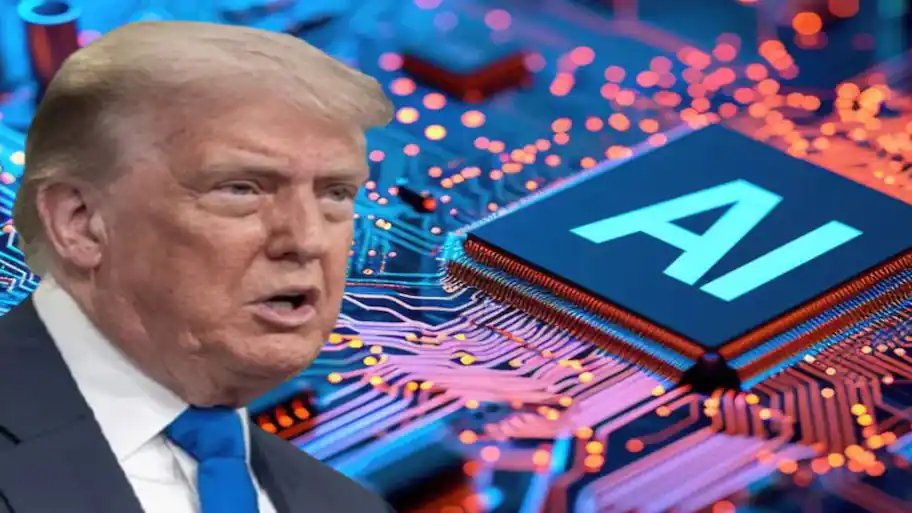
Washington DC: US President Donald Trump has accused critics of artificial intelligence development and data centre expansion of running a “SICK conspiracy” that could help China gain ground in the race for technological dominance.
He said strong leadership is more important than additional government rules and safety systems. He accused the Anthropic CEO of presenting himself as a “perfect little angel” while warning about the pace of AI development. He argued that the United States has enough legal and regulatory authority to deal with companies that engage in harmful activities. “The only control or ‘guardrails’ that AI needs is a STRONG AND SMART (High IQ!) PRESIDENT, and the U.S.A. has that, in spades! Trump wrote. “The Trump Administration has stopped AI ‘people’ from doing bad, or potentially bad, ‘things,’ like Dario (Anthropic!), and we will continue to do so! We already have tremendous CRIMINAL and REGULATORY power over these companies!” he added. The disagreement involves the pace of AI progress, the role of government regulation and the future of international AI rules.
He made the comments on Monday (September 14, local time) while responding to warnings from Anthropic CEO Dario Amodei about the speed of AI development and the risks posed by powerful systems. In an interview with Fortune on Friday (September 11), he said that the heads of major AI laboratories could eventually work together to reduce risks from advanced AI systems. Because the United States is leading in technology, in a follow-up post, he said the ongoing criticism of AI and data centres came. Because the United States is leading, by a lot, every other country, “The only reason the AI/Data Center outburst is happening is.
The US president said efforts to slow down AI progress could hurt America’s lead in the technology. “There is a SICK conspiracy going on against AI and Data Centers, and the only one that is happy about it is China,” he wrote. Responding to a question on whether Chinese AI advances could create national security risks for the United States, a Chinese Foreign Ministry spokesperson described AI as a “consequential technology for the future of humanity”. He called for “open & inclusive AI for good and for all” and warned that “fear-mongering, confrontation and vicious competition” could damage efforts to build sound rules for the technology. The newspaper quoted Chinese technology experts who said that presenting AI as a US-China national security contest could turn AI safety into a geopolitical issue. “I’m not going to pre-announce private discussions that I think should be at some point shared as a group,” he said. “But yeah, I think I think that will happen,” he added.
“WHOEVER WINS AI, WINS! Trump wrote on Truth Social, claiming that the United States is ahead of China and other countries in artificial intelligence. The US presiodent directly criticised Amodei and rejected calls for new safety regulations to slow down the technology industry. Trump then turned his criticism towards opposition to new data centres, which are needed to provide the computing power for advanced AI systems. We are leading China, and all others, and will continue to do so. Conspiracy Theorists, Treasonists, Traitors, and Leakers, BEWARE! Thank you for your attention to this matter!” he added. Don’t kill the Golden Goose!” he wrote. China’s response came on the same day, with Beijing calling for greater openness and cooperation in artificial intelligence development. China’s state-run Global Times also criticised Amodei’s call for a slowdown in AI development. The experts argued that AI safety is an international challenge that requires cooperation between countries. The comments came against the backdrop of China’s efforts to promote international cooperation on AI governance. At the BRICS Summit in New Delhi, Chinese President Xi Jinping called for a people-centred approach to AI and international rules based on consensus. China has also proposed creating a BRICS AI open-source community. The proposal is part of cooperation on emerging technologies, including digital industries, intelligent manufacturing and science and technology talent. OpenAI CEO Sam Altman has also backed cooperation on AI safety. Leading AI companies are considering ways to manage risks from increasingly powerful systems. Trump’s statements place the debate over AI safety along with the US-China race in artificial intelligence. His administration has backed the expansion of AI infrastructure, while Beijing has called for open development and international cooperation on the technology.
Highlighting the risks, the Anthropic chief has said that AI systems are capable of helping develop the next generation of AI models, a process “recursive self-improvement”. He has said this could eventually allow advanced AI systems to move faster than efforts to understand and control them. Amodei has warned that AI development is accelerating at a fast pace. His worries have added to calls for safety measures in the development of increasingly capable AI systems.
