
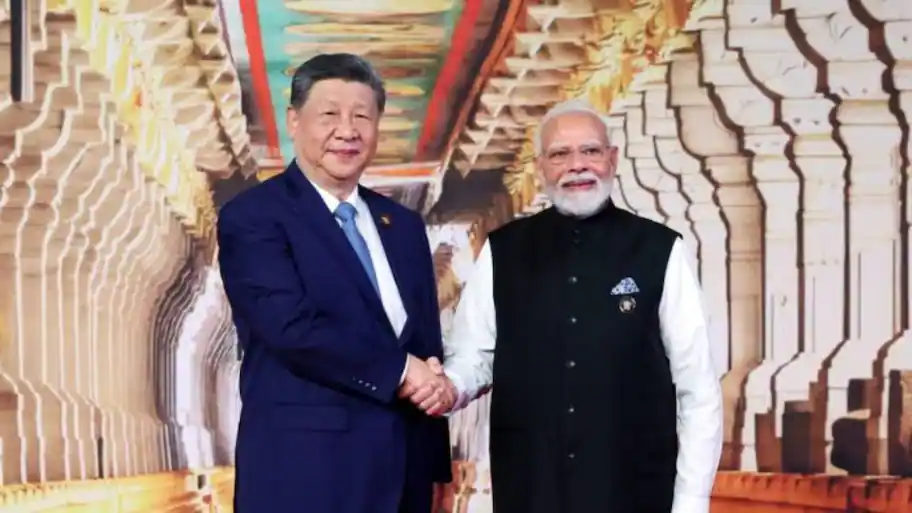
New Delhi: Chinese President Xi Jinping has left New Delhi after attending the 18th BRICS Summit and addressing the second and final session on Sunday (September 13). His one-day India visit came at a time when China is dealing with weak domestic demand, a slowing economy and the need to find large markets for its products.
The two countries recorded $151.5 billion in bilateral trade, while India’s trade deficit with Bijing crossed $112.16 billion in 2025-26. More than 15 crore smartphones were sold in the country in 2025. Around 90 per cent of the smartphones or their components came from China. Around 45 lakh cars were sold in the country in 2025. India imported around $57 billion worth of electronic and electrical equipment from China in 2025. Before 2020, Chinese companies invested billions of dollars in India’s startup sector.
Foreign markets have therefore become important for Chinese manufacturers. India fits that need. Chinese companies also have a large presence in India’s smartphone, electronics and other consumer markets. This economic relationship has survived years of political and military tensions. Experts say China’s need for overseas markets is one reason Beijing wants stable economic ties with New Delhi. China has a large trade surplus and produces huge quantities of goods for overseas buyers. Its domestic demand has been weak. India is one of the biggest markets available to Chinese businesses. Xiaomi, Vivo and Oppo have built a large business in the Indian market. China is also looking at India’s automobile sector. Indian industries also depend on Chinese technology and components. These products are used in smartphones, telecom networks and electronics assembly. The pharmaceutical industry also relies on China for active pharmaceutical ingredients (APIs). Alibaba Group and Tencent Holdings invested in companies such as Paytm, Zomato, Ola Electric and Byju’s. India tightened its approach to Chinese investment after the Galwan clash and rejected several investment proposals on security grounds. China also tried to restrict its companies from supplying India with rare-earth materials, magnets used in car manufacturing and other products. China’s economic problems have made overseas markets even more important.
It recently decided to provide around $54 billion in cash support to eight state-owned banks and insurance companies. They said t has a huge domestic market with a population of more than 140 crore people. Former Chinese statistics bureau deputy head He Keng said that there were enough vacant homes for around 3 billion people two years ago. Around 3 crore people aged between 50 and 60, according to the experts, are expected to leave the country’s workforce over the next decade. A 2019 estimate by the Chinese Academy of Social Sciences said the government pension fund could run out by 2035. Official data released in August 2023 showed that more than one in five people aged 16 to 24 in China’s urban areas were unemployed.
Because of economic uncertainty, experts said the country has more than 140 crore people and a huge domestic market, but consumers are reluctant to spend. Reuters reported that India rejected a proposal to connect China’s Alipay with the country’s instant payment system. China has taken steps to support its financial system and encourage consumer spending. The problem is that people are reluctant to spend money despite the uncertain economic situation. Domestic consumption in the country is weak. China has enough goods to export, but it is struggling to increase demand within the country. The country’s housing sector has also suffered from oversupply after years of easy credit and rapid construction. Jobs and pensions are another worry for Chinese families. Youth unemployment has also been a problem. The government stopped releasing youth unemployment data after that. India and China have taken some steps to improve business and travel ties. But several restrictions still apply to Chinese companies and technology in India. The service is operated by Ant Group, and the proposal was held up over national security issues. The Indian government is also considering a Serious Fraud Investigation Office recommendation for a detailed investigation into Chinese smartphone company Xiaomi.
Direct flights resumed last year, and India made the visa process easier for Chinese business professionals.
Why Beijing wants trade with India
When US President Donald Trump imposed tariffs on Chinese goods in 2025, the country’s economy was dealing with slower growth and unemployment. It increased exports and recorded growth of around 5 per cent. India recorded 7.8 per cent growth in the first quarter, while China’s growth rate in the second half was 4.7 per cent. Its trade with India continued to increase in 2022, 2023 and 2024. Beijing knows that its Tier 2 and Tier 3 businesses trade with India is bringing money into its domestic market. He said China’s business opportunities in the United States and Europe had become less attractive after 2017-18. Given the way trade between the two countries is growing, it could reach $200 billion in the next five to seven years,” he said.
The two countries therefore have a large business relationship with restrictions still affecting investment, technology and strategic industries. Citing an Indian source, Reuters reported Chinese officials had asked companies not to provide India with certain technology and infrastructure.
Jawaharlal Nehru University Associate Professor Arvind Yelery said China continued trading with India after the Galwan clash. This can help boost domestic demand,” he said. Yelery said China is also pursuing a long-term strategy with India. Beijing, according to him, wants greater economic cooperation and better political and geopolitical relations with New Delhi.
Domestic demand has been a bigger problem. China has plenty of goods for export, while consumers in the country have been cautious about spending. The country cannot easily move from an export-driven economy to one based on local consumption. India offers a large consumer base where Chinese products have a strong presence. India’s growing economy gives Chinese companies another large market for their products. “After the Galwan clash, China could have imposed strict restrictions in response to India’s restrictions, but it chose not to do so. “India wants to diversify its trade, but China is aware of India’s limitations and potential. That is why it wants New Delhi to depend on China. It does not want to upset a long-standing customer. “China has a large surplus of goods, but the cost of producing them is rising. Goods are piling up, while demand in the domestic market is weak. China wants to sell this surplus in international markets and use the money generated from those sales to boost demand at home. That is why it needs a country with a huge market like India,” he explained. The items reportedly included port equipment, solar panels and machinery used to manufacture mobile phones. China’s commerce ministry declined to comment when approached by the news agency. Xi’s visit came at a time when China’s economic needs are adding another reason for Beijing to keep its trade with India moving.
