
Jaishankar in February 2024 during the Munich Security Conference.
“I would characterise India as a country which is non-West, but a nation which has an extremely strong relationship with Western countries, and that is getting better by the day,” said India’s External Affairs Minister S.
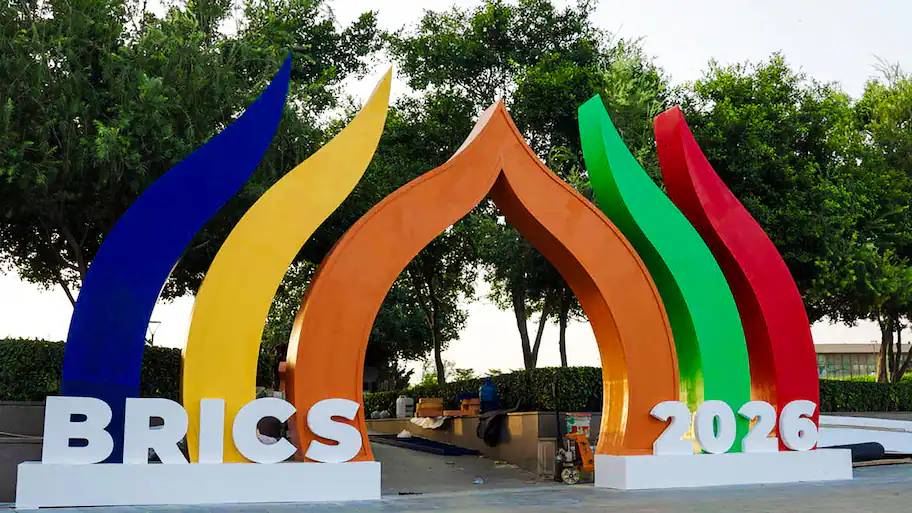
As New Delhi hosts the 2026 BRICS Summit this weekend, the above distinction is likely to remain at the heart of India’s diplomatic approach. Jaishankar made this point at the GLOBSEC Forum in Bratislava in June 2022, saying India did not accept that it had to join either a US-led or China-led axis. Prime Minister Narendra Modi highlighted this approach at the BRICS Summit in Kazan in October 2024, welcoming greater financial integration and saying that trade in local currencies and smoother cross-border payments could strengthen economic cooperation. At the BRICS Summit in Johannesburg in August 2023, Modi said India was ready to share its Digital Public Infrastructure experience with partner nations to promote financial inclusion. For India, maintaining that balance will be crucial during its 2026 chairmanship, particularly amid the ongoing war in West Asia and the sharply differing positions of BRICS members.
Speaking at the Hudson Institute in Washington in September 2023, Jaishankar said India was “non-Western” but “not anti-Western”, stressing that New Delhi did not approach the international system with the intention of pulling down its existing pillars. Jaishankar described this broader ambition in September 2023 when he argued that the world needed a form of “re-globalisation” and that India’s role was to add a non-Western layer to the existing global architecture while making international institutions more fit for purpose. With BRICS expanding and global tensions deepening, the grouping is often portrayed as a potential counterweight to the United States and the wider Western bloc. India, however, does not see BRICS in those terms. For New Delhi, the grouping is an opportunity to push for a more representative global order, strengthen cooperation among developing economies and address practical economic challenges. The objective is not to dismantle the existing international system or create a bloc designed to confront the West. That position reflects a broader Indian strategy of maintaining strategic autonomy while building relationships across competing centres of power. India’s position has been articulated repeatedly by EAM S Jaishankar, who has argued that New Delhi’s approach is reformist rather than revisionist. As BRICS marks its 20th year of existence, the distinction is particularly important as the bloc has grown beyond its original five members and taken on greater geopolitical significance. Countries such as Russia and China have often been more openly critical of Western-led institutions and the existing global power structure. India, by contrast, has sought to push for reforms within that structure while retaining strong partnerships with Western countries. For New Delhi, the argument is not about replacing one dominant bloc with another. It is about ensuring that countries of the Global South have a greater voice in institutions that shape global economic and political decisions. This thinking also explains India’s policy of multi-alignment. New Delhi is a member of the Quad alongside the United States, Japan and Australia, while also remaining an active member of BRICS alongside Russia and China. It maintains important relationships with Western economies while simultaneously deepening ties with countries across Asia, Africa, Latin America and the wider Global South. India’s position is that it should not be forced to choose between competing power centres. With its large population and major economy, he argued, India was entitled to weigh its own interests. This is the essence of New Delhi’s multi-alignment: partnerships are not necessarily exclusive, and cooperation in one forum does not require confrontation in another. India’s approach to BRICS is also rooted in practical economic cooperation. One area is trade in local currencies. New Delhi has supported greater use of national currencies for settling trade between BRICS members, arguing that smoother cross-border payments can reduce transaction costs and make trade more resilient to external shocks. The objective, from India’s perspective, is not to wage a campaign against the US dollar. Instead, it is about giving countries more options and making international trade more efficient. India is also pushing its experience with digital public infrastructure (DPI) as another area of cooperation. Platforms such as UPI have demonstrated how digital payment infrastructure can expand access to financial services. India has offered to share its experience with other developing countries, particularly across the Global South, as they build their own digital ecosystems. The message is clear: India wants BRICS to deliver tangible economic benefits rather than become consumed by geopolitical confrontation. The challenge for India is that BRICS is no longer a relatively small grouping of emerging economies. Its expanded membership brings together countries with very different economic models, foreign-policy priorities and strategic interests. The grouping includes major energy producers, large energy consumers and countries that have their own political, territorial or strategic disagreements. That diversity makes consensus harder, but it also makes India’s role as host more important. New Delhi’s task is to keep the focus on areas where members can cooperate while preventing internal disagreements from turning BRICS into a platform dominated by the agenda of any one power. India has repeatedly described BRICS as an outcome-oriented and consensus-driven platform, rather than an organisation belonging to any single country. Modi has also stressed the need for the expanded BRICS family to contribute to global governance reform and ensure that the voices of the Global South are better represented. The larger significance of India’s BRICS strategy lies beyond the summit itself. New Delhi is attempting to demonstrate that countries in the Global South do not have to choose between two extremes: aligning completely with Western powers or building an opposing bloc against them. India’s preferred route is to work with different partners on different issues while preserving the freedom to make independent decisions. That explains why New Delhi can simultaneously engage with the US and its allies through platforms such as the Quad, maintain longstanding ties with Russia, manage a complex relationship with China and lead discussions within BRICS. The approach is less about choosing a camp and more about expanding India’s room for manoeuvre. As BRICS members meets in New Delhi on from 12th September to 13th September, India’s challenge will be to push for a more representative global order.
