
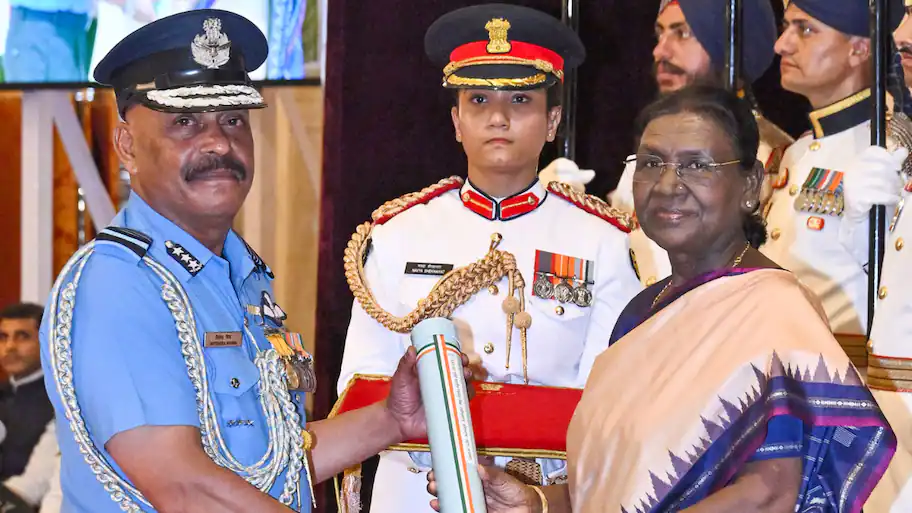
From flying fighter aircraft and handling some of the Indian Air Force’s toughest assignments to now overseeing the administration of the Ram Mandir Trust in Ayodhya — Air Marshal Jeetendra Mishra’s (Retd.) career has taken a remarkable turn.
Mishra was selected from a shortlist of three candidates prepared after the Trust received 5,585 applications. Mishra joined the Indian Air Force’s fighter stream on December 6, 1986. What followed was a career spanning more than 38 years, during which he accumulated over 3,000 hours of flying experience. He flew more than 18 types of fighter and transport aircraft and helicopters and served in several demanding roles — as a fighter pilot, fighter combat leader, experimental test pilot and instructor. As a Squadron Leader, he was part of the team that helped operationalise laser-guided bombs on Mirage 2000 aircraft at the beginning of the conflict. In 2010, he was chosen to lead the Indian Air Force contingent at the multinational Garuda IV air exercise in France. As an Air Commodore, he commanded 15 Wing at Bareilly and 18 Wing at Pathankot. In January 2023, he became Deputy Chief of Integrated Defence Staff (Doctrine, Organisation and Training). On January 1, 2025, Mishra took over as the Air Officer Commanding-in-Chief of the Western Air Command. He retired from the IAF on April 30, 2026, after more than 38 years of service. He had earlier received the Ati Vishisht Seva Medal (AVSM) in 2024 and the Vishisht Seva Medal (VSM) in 2013.
Because of his role during Operation Sindoor, when he was heading the Western Air Command, mishra’s name became particularly prominent.
The Trust says the CEO will develop systems and procedures, strengthen the organisational structure and oversee officers, employees and other staff. The Trust has said the move towards a professional CEO is intended to strengthen its administration and organisational systems. The retired Air Marshal has been appointed the first full-time Chief Executive Officer (CEO) of the Shri Ram Janmabhoomi Teerth Kshetra Trust, which manages the Ram Temple in Ayodhya. His appointment comes at an important time for the Trust, which is looking to strengthen its administration, systems and financial oversight as the temple complex expands. But who is Jeetendra Mishra, and what does a decorated Air Force commander bring to the management of one of India’s most prominent religious institutions? Mishra has his roots in Bhopatpura in Uttar Pradesh’s Deoria district. He comes from a middle-class family, with his father having worked as a lecturer. His connection to Uttar Pradesh now takes on a new significance as he takes up one of the most important administrative roles at the Ram Janmabhoomi temple. One of the defining chapters of Mishra’s military career came during the Kargil War. Those weapons were subsequently used during attacks on key Pakistani positions, including Tiger Hill and Muntho Dhalo, under Operation Safed Sagar. His career then moved beyond flying and combat operations. He served as a fighter squadron commander in the Eastern Sector and later became chief test pilot at Hindustan Aeronautics Limited’s Nasik division. As a Group Captain, he was the Chief Test Pilot at the Aircraft and Systems Testing Establishment and also served at Air Headquarters in operational planning and assessment. Mishra continued to rise through the IAF hierarchy. He later served at Air Headquarters and, after becoming an Air Vice Marshal, held positions including Assistant Chief of Air Staff (Projects) and Commandant of the Aircraft and Systems Testing Establishment. Later that year, he took charge as Deputy Chief of Integrated Defence Staff (Operations). Then came one of the biggest responsibilities of his military career. His leadership during the operation was recognised with the Sarvottam Yudh Seva Medal, one of India’s highest wartime military honours. In a later interview, Mishra also spoke about the air campaign during Operation Sindoor, explaining how targets deep inside Pakistan were identified and struck. He highlighted the importance of planning, precision, technology and coordination while keeping sensitive operational details classified. Just months after retiring from the Air Force, Mishra has taken on a completely different-looking assignment — but one that will still require organisation, discipline and the ability to manage a large institution. As the first full-time CEO of the Ram Mandir Trust, he will be responsible for strengthening the Trust’s administrative machinery and ensuring that its day-to-day functioning runs smoothly. The post also involves ensuring that the Trust’s activities comply with statutory, regulatory and Trust Deed requirements. His responsibilities are expected to extend across the Trust’s growing operations, including coordination related to pilgrim facilities, staff, finances, security and major religious events. The choice of a former senior military commander for the job is significant. The Ram Mandir is no longer simply a construction project. With millions of devotees expected to visit Ayodhya, the Trust has to manage a large and complex organisation involving pilgrims, employees, finances, infrastructure, security and major religious events. That is where Mishra’s decades of experience could become useful. His military career was built around planning, coordination, managing people and resources, taking decisions under pressure and running large organisations. The challenge in Ayodhya will obviously be very different from commanding an Air Force formation, but the administrative skills involved can overlap. The appointment also comes amid scrutiny over the management of temple donations and calls for greater transparency. For nearly four decades, Jeetendra Mishra’s work was centred on India’s air power — fighter aircraft, military operations, strategic planning and national security. Now, his mission is in Ayodhya. There will be no fighter jets or combat operations in his new office. Instead, the retired Air Marshal will have to deal with the everyday challenges of running one of India’s most closely watched religious institutions. In that sense, Mishra’s journey from Kargil and Operation Sindoor to the Ram Mandir Trust is not just a change of job. It is a transition from military command to institutional management- with the spotlight of Ayodhya now firmly on him.
