
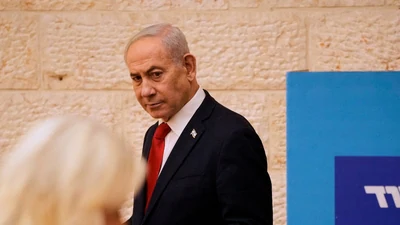
TROJAN HORSES seem to be rearing up everywhere this summer. Binyamin Netanyahu, Israel’s prime minister, has featured the wooden steed in a campaign video for Israel’s parliamentary election on October 27th. In the ad, an AI-generated Gadi Eisenkot , a former general now leading the polls, rides the horse. Lurking inside are Mansour Abbas and Yair Golan, two other opposition leaders.
In 2021 he supported a government led by Naftali Bennett, a right-wing politician who is running again this year. Mr Golan’s opponents are now using these quotes to depict his party as radical and non-Zionist, and therefore unfit for government.
A decade ago, when he was deputy chief of staff of the Israel Defence Forces, he likened what was happening in Israel to “horrifying processes that occurred in Europe” before the Holocaust. More recently, during the war in Gaza, he said that “a sane state does not wage war against civilians, does not kill babies as a hobby, and does not set goals for itself like the expulsion of a population . In public Mr Eisenkot has said he will consider governing with any party that accepts a vague set of principles he has laid out, such as the values of Israel’s declaration of independence. His alliance of hard-right and religious parties may not be capable, according to most polls, of winning a majority, but he is already dictating the terms by which his rivals will try to form a government.
His efforts to do the same to a Jewish and Zionist party mark something new. At times Mr Golan, another former general, has given his right-wing opponents ammunition. So far these efforts seem to be of little effect. The polls are not moving in Mr Netanyahu’s favour and none of the other leaders of main opposition parties has ruled out including the Democrats in their coalition. When it comes to including an Arab party in the next government, however, Likud has indeed managed to split the opposition. Mr Golan is the only one to be openly in favour of doing so. All his potential partners in the next coalition are either adamantly opposed to working with the Arab parties or have been evasive. But he would rather lead a minority government, however unstable, than include Israel’s Arab representatives. Mr Netanyahu is succeeding in one more sense. His campaign is steadily pushing Mr Eisenkot towards harsher nationalist positions; he recently categorically ruled out the possibility of accepting a Palestinian state if he establishes a government. On his present trajectory, he may be unable to form anything better than an unstable and short-lived government which will be bound, judging by his election statements, to policies not unlike those of the outgoing one. As for Mr Abbas, one of the canniest politicians in Israel, he is the only Arab-Israeli leader to have joined a ruling coalition. Mr Abbas blames the other Arab-Israeli parties, which are running together on a joint list, of refusing to make the necessary compromises to be in government and so effect meaningful change. To boost his chances of being part of a ruling coalition once again, he has come up with an interesting ploy.
