
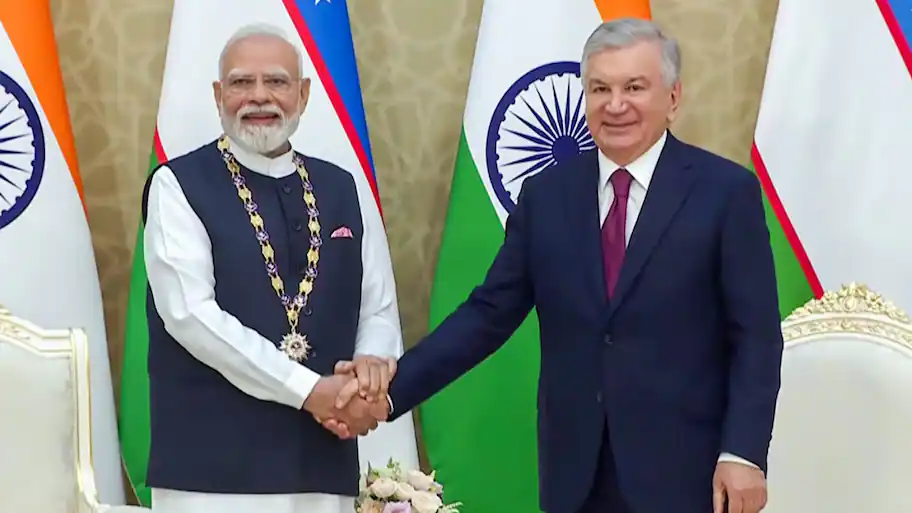
India and Uzbekistan have agreed to work towards a Preferential Trade Agreement (PTA) and establish a Joint Working Group to tackle non-tariff barriers and investment hurdles as both countries look to significantly expand trade and investment.
The two sides have set an ambitious target of increasing bilateral trade to USD 5 billion by 2030, up from more than USD 1 billion currently. “This year marks 15 years of our strategic partnership. Our bilateral trade has crossed USD 1 billion, and we have now set a target of USD 5 billion by 2030.
To achieve this, we will systematically move forward on market access, connectivity, and banking,” PM Modi said. The focus will be on improving market access, strengthening connectivity and developing better banking and payment channels. On this special occasion, we have decided to elevate our relations to a ‘Comprehensive Strategic Partnership’. We have prepared an ambitious agenda to move forward with speed.
Addressing a joint press statement with Uzbek President Shavkat Mirziyoyev in Tashkent on Sunday, Prime Minister Narendra Modi said expanding trade would remain a key priority in the bilateral economic relationship.
The leaders also welcomed the outcomes of the Intergovernmental Commission on Trade, Economic, Scientific and Technical Cooperation and the Uzbekistan-India Business Forums held in June and August 2026. The latest agreements were announced as part of Prime Minister Modi’s state visit to Uzbekistan from August 29 to 30, at the invitation of President Mirziyoyev. India and Uzbekistan established diplomatic relations on March 18, 1992, following the signing of a protocol in Tashkent. The two countries upgraded their relationship to a Strategic Partnership in 2011.
India and Uzbekistan will take joint steps to expand the range of goods traded between the two countries, remove non-tariff barriers and encourage greater industrial cooperation, according to the joint statement issued during Modi’s state visit to Uzbekistan. “The two Leaders expressed satisfaction at the steady growth of bilateral trade and reaffirmed their resolve to further expand and diversify trade, with the aim of building a stronger trade relationship,” the Joint Statement said. the leaders noted that there is still “considerable untapped potential” to expand bilateral trade and investment While welcoming the strong economic partnership between the two countries. The two leaders held discussions in a “warm, friendly and constructive atmosphere” and carried out a comprehensive review of bilateral relations, along with regional and international issues of mutual interest.
The two countries have also agreed to establish a Joint Working Group to address non-tariff issues and investment barriers, particularly in important sectors of bilateral trade. India and Uzbekistan also took note of the conclusion of the Joint Feasibility Study on the Uzbekistan-India Preferential Trade Agreement. They directed their respective ministries to examine the next steps on a time-bound basis. The leaders agreed to support efforts to strengthen manufacturing and export capabilities and promote dialogue between regulators. They will also explore mutual recognition arrangements to help provide faster and greater access to each other’s markets. India and Uzbekistan expressed interest in expanding cooperation in e-commerce, digitalisation of trade procedures and digital platforms for small and medium-sized enterprises. These efforts are aimed at making bilateral trade easier and more efficient. Uzbekistan also appreciated India’s support for its accession to the World Trade Organisation (WTO). Both sides agreed to work together to preserve the multilateral trading system, with the WTO at its core, particularly in the interests of developing countries. The two leaders also agreed to encourage greater collaboration between Indian and Uzbek companies, make use of the complementary strengths of both economies and improve connectivity between their value-added supply chains. They identified electrical items, engineering products, automobiles and pharmaceuticals as sectors with considerable potential for expanding bilateral trade. Both sides agreed to encourage closer business-to-business ties in these areas. On investment, the leaders agreed to identify and promote mutually beneficial opportunities and create an institutional mechanism to address investors’ concerns and make it easier to do business. India and Uzbekistan will also explore stronger cooperation between Uzbekistan’s Investment Promotion Agency and Invest India through joint business forums, roadshows, investment seminars and interactions with stakeholders. The initiatives are aimed at increasing two-way investment flows and strengthening business-to-business connections. They also pointed to the rapidly growing number of Indian companies operating in Uzbekistan as a sign of the significant scope for further economic cooperation. The economic push comes as India and Uzbekistan upgraded their bilateral relationship to a Comprehensive Strategic Partnership, marking a new phase in their longstanding ties. The two countries agreed to deepen cooperation in a wide range of areas, including trade, economy and investment; transport connectivity; digital transformation, including IT and AI; space; cybersecurity; energy transition; critical minerals; food security; healthcare; pharmaceuticals; and education. They noted that these engagements had made a significant contribution to expanding trade, economic and investment cooperation between the two countries. Modi’s current visit marks another important step in strengthening economic ties, with both countries seeking to turn their upgraded Comprehensive Strategic Partnership into greater trade, investment and business cooperation. (with ANI inputs)
