
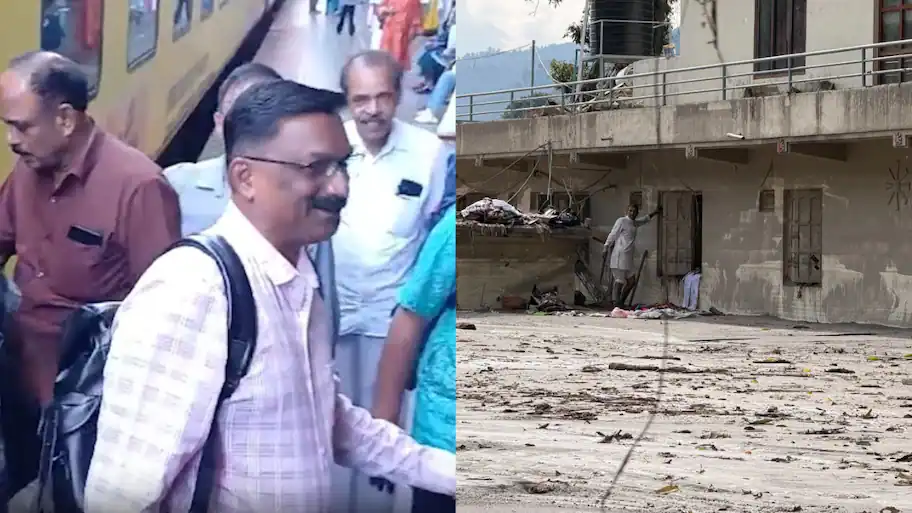
A total of 149 Indian nationals have been rescued from Nepal, the Ministry of External Affairs (MEA) said on Sunday. The ministry also shared a list of all 149 rescued Indians as of 5.30 pm. Indian nationals rescued from flood-hit Nepal have returned home, recounting terrifying moments when they came within minutes of being caught in the devastating flash floods that swept through parts of the Himalayan nation.
“That day, we left our hotel in Kathmandu at 6:30 a.m in two tourist buses. In Kerala’s Kasaragod, five members of a 36-member Malayali group also returned safely after being stranded in Nepal. One of the rescued travellers recalled the terrifying scenes they witnessed while travelling from Kathmandu towards the Manakamana Temple in Gorkha district on August 26. “On August 26, we were on our way to the Manakamana Temple (in Gorkha district) from Kathmandu. “In the afternoon, we diverted the bus into a forest area and travelled around 60 kilometres into the forest…our vehicle was breaking down repeatedly. The MEA said the fourth flight carrying 11 tonnes of relief assistance landed in Nepal on Sunday and the material was handed over. External Affairs Minister S Jaishankar said on Saturday that 16 trucks carrying equipment for a 230-foot single-lane modular steel bridge had reached Nepal. So far, a total of 68.5 tonnes of relief material comprising essential medicines, portable generator sets, food packets, water purification tablets and technical equipment have been airlifted to Kathmandu,” he said on X.
Later, the driver told us that a landslide warning had been issued. Many were running uphill,” he told IANS. From there, Poddar said, they watched what appeared to be a huge white mass rushing down the river. After some time, the driver said we had to turn back; otherwise we would not be able to return if the road got blocked. We are extremely thankful to (Chief Minister) Devendra Fadnavis ji,” she told IANS. All of us were scared since we did not know what to do,” she said. He said the group soon realised the scale of the disaster. “So we followed them and then saw from a distance that parts of buildings, trees, people and smaller vehicles were being swept away into the river…locals said that a dam had breached upstream. At that time, we thought that we would not be able to go back home,” he said. The MEA said the team would work with its Nepali counterparts to analyse DNA samples and help identify the mortal remains of those killed in the disaster.
Among those who made it home safely were people from West Bengal, Maharashtra and Kerala, many of whom described narrow escapes and chaotic journeys to safety. After returning to Basirhat in West Bengal, Anukul Poddar recalled how he was travelling with a tourist group from Kathmandu towards Rasuwa, near the Nepal-China border, when the disaster struck. After about three to four hours, both vehicles stopped. The administration had informed the drivers, and they could not proceed further…Sitting in the vehicle, we saw schoolchildren crowding the road as schools had been closed. The drivers eventually moved the group to higher ground. “Later, the drivers took us to a higher place on the hill. All we could see was a white, cloud-like mass flowing down the river. We had never witnessed anything like it. We stood on the hill for a while and watched the mass gradually descend. The driver then quickly took us back to the hotel in Kathmandu. A family from Maharashtra also described how narrowly they escaped the floods. Speaking after getting off a train at a railway station in Nagpur, a woman thanked the Maharashtra government for helping her family return home. “We went to Nepal for a trip; the situation there was very difficult…I am grateful to the Maharashtra government for making it possible for us to return to the city by using its links in Nepal. The family managed to complete their tour but were left shaken by what happened around them. The driver stopped the bus while on the way, saying that there had been an accident. we saw passengers getting down from vehicles beside us and running to the lower side of the road While waiting inside the bus. Only later, we got to know from social media that a flash flood had struck the area. With roads becoming increasingly difficult to navigate, the group took a long detour through a forest. Alongside rescuing stranded Indian nationals, India has continued to send relief and technical assistance to Nepal. The consignment included a tunnel technical contingent and equipment for search and rescue operations, forensic experts for DNA analysis, as well as blankets, sleeping bags, tarpaulins, plastic sheets and hygiene kits. “Equipment for installation of seven more Bailey bridges will be supplied soon. Technical teams for their installation are expected to reach shortly. Indian Ambassador to Nepal Naveen Srivastava also met members of the Indian Forensic Team deployed in the country to help identify victims of the flash floods. “Ambassador Naveen Srivastava met members of the Indian Forensic Team deployed to Nepal. The team will work alongside their Nepali counterparts in analysing DNA samples to assist in identifying the mortal remains of the victims of the recent flash floods,” the MEA stated on X. As rescue and relief operations continue, the accounts of those who have returned underline how quickly the floods turned routine journeys into desperate escapes, with several survivors saying they were saved by little more than timing and luck. (With IANS inputs)
“A bus got swept away from the same place through which our bus had passed fifteen minutes earlier.
