
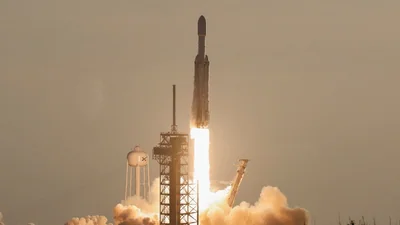
NASA is set to launch the Nancy Grace Roman Space Telescope, a state-of-the-art observatory designed to investigate some of the universe’s most profound mysteries. This telescope will concentrate on critical areas of research, including dark matter, dark energy, and exoplanets, as well as the physics of distant stars. By doing so, it aims to provide scientists with an expanded understanding of the workings of the universe.
Roman will send huge amounts of data to Earth
Its field of view will be at least 100 times larger than Hubble’s, allowing scientists to survey huge areas of the universe in a much shorter time, according to NPR. NASA expects Roman to find about 1,000 planets through microlensing, according to NPR. Roman will send back around 1.4 terabytes of raw science data every day.
Scientists and members of the public will be able to access the data, according to NPR. By the end of Roman’s planned five-year prime mission, its database could be larger than a typical music-streaming platform’s database, NASA scientist Jeremy Perkins told NPR. Perkins said some of the most exciting discoveries could come from unexpected observations, including rare events that scientists may see only once in a million cases.
The Nancy Grace Roman Space Telescope is about the size of a tour bus, making it a huge observatory designed to carry out a wide range of space research. Roman will have a level of sharpness similar to Hubble but will be able to see a much larger part of the sky at once. Roman will study how dark matter’s gravity slightly bends or changes the path of light travelling through space. By studying these small changes in light, scientists can make maps showing where normal matter and dark matter are found across large parts of the universe. This could help scientists better understand what dark matter is and how it affects the universe. This method looks for tiny changes in the light from distant stars caused by the gravity of a planet. This method could help scientists find planets that are difficult to detect with other planet-hunting methods. Roman will also demonstrate technology designed to block the bright light coming from a star. Blocking the star’s light could allow the telescope to directly capture an image of a planet orbiting that star. This technology could give astronomers another way to study planets beyond our solar system and learn more about worlds that are otherwise hidden by the brightness of their stars. The telescope is expected to generate an enormous amount of scientific information once it begins its mission. It will use a refrigerator-sized high-gain antenna to send the data back to Earth. The data will not be kept only for NASA scientists. NASA is creating a cloud-based system called Roman Nexus to handle the telescope’s massive amount of information. The scale of the data is expected to be enormous. Making the data publicly available could allow researchers around the world — and even members of the public — to study Roman’s observations and potentially find something NASA scientists were not specifically looking for.
