
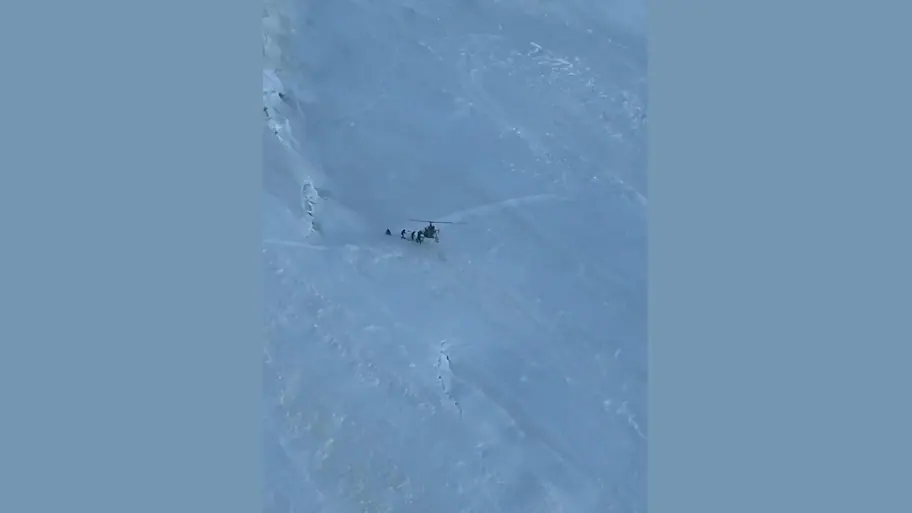
New Delhi: The Indian Army carried out a daring high-altitude rescue operation near the Nun Kun mountain range and evacuated a patient from a steep slope at an altitude of 18,600 feet.
The mission was conducted in difficult conditions, with strong winds, thin air and extremely limited space for the helicopter to operate. The terrain left no suitable area for a conventional landing, forcing the aviation crew to depend on a carefully executed technical rescue.
The pilots brought the helicopter into a low hover close to the slope and carefully balanced the aircraft so that only one of its skids touched the steep mountainside. Because thin air, strong winds, steep terrain and changing weather conditions can directly affect helicopter performance, operations at such elevations require specialised aviation skills. At such a high aaltitude, reduced air pressure affects helicopter performance. Engine power and rotor lift decrease that leave the aircraft with less lifting capacity. The aircraft was also flown with limited fuel to maximise its lifting capacity while keeping enough range for the rescue operation. The preparations were aimed at giving the helicopter the best possible performance in the high-altitude conditions. When the crew reached the patient, they faced strong mountain winds and a steep slope where there was no room to land the helicopter. The weather and terrain left little margin for error during the evacuation. This allowed the crew to secure the patient and bring him aboard without requiring a conventional landing. The patient was secured fast while the helicopter was held in position. The aircraft then took off from the difficult location and carried out the evacuation safely. The operation was conducted by the Indian Army’s Fire and Fury Corps, which shared photographs of the rescue on social media platform X. The formation wrote, “The mission, undertaken at the last available landing window of the day, stands as a testament to the skill, courage and compassion of Indian Army Aviation. The rescue involved careful coordination between the pilots and the ground team as they worked within a narrow window for the aircraft to reach the patient and evacuate him. The helicopter’s reduced weight and limited fuel load were part of the preparations made for operating at such a high altitude. The Nun Kun range is located in the Ladakh region and includes some of the highest peaks in the area. The Army’s aviation units routinely support troops and civilians in high-altitude areas, including casualty evacuation missions from remote locations where road access is unavailable or impractical.
The Army reduced the helicopter’s weight by removing all non-essential equipment before the mission.
