
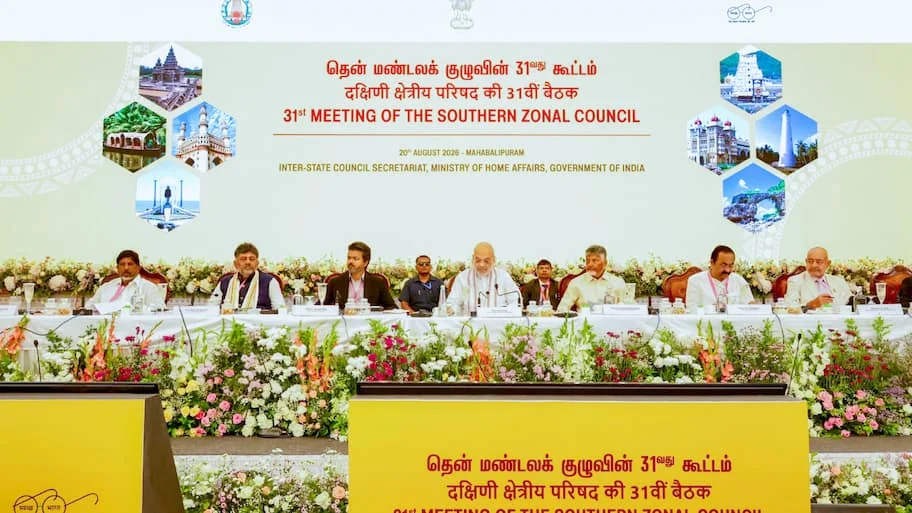
Southern states on Thursday pressed for a greater and fairer share of financial resources, stronger political representation and closer regional cooperation at the 31st Southern Zonal Council meeting chaired by Union Home Minister Amit Shah in Mahabalipuram.
He also urged the Centre to reconsider the Mines and Minerals (Development and Regulation) Act, 2026, arguing that it affects the states’ rights to levy taxes on major minerals. Earlier reporting noted: The Southern Zonal Council is a statutory advisory body created under the States Reorganisation Act, 1956. Because of successful population control, on delimitation, he demanded a legislative assurance that no state’s percentage share of parliamentary representation would be reduced.
Shivakumar said Karnataka’s approach was based on equality, transparency and cooperation, while stressing that the state’s legitimate water rights must also be respected. He said Karnataka would place its specific positions on the Krishna river, the Upper Bhadra project and the interlinking of rivers before the council. On inter-state river disputes, Vijay said the rights of lower riparian states must be protected through the implementation of court judgments, tribunal awards and statutory mechanisms. “Public policy must not penalise states for fulfilling national objectives,” he said.
Tamil Nadu Chief Minister C. Joseph Vijay also called for greater cooperation among southern states, particularly on drug trafficking, economic development, the Blue Economy and federal rights. Vijay concluded by saying that strong states make India stronger and pledged Tamil Nadu’s cooperation in resolving differences through dialogue, mutual respect and the rule of law. Key areas include water sharing, inter-state disputes, infrastructure, education, law and order and other matters that need coordination between governments. It provides a formal platform where states and the Centre can discuss common problems and work towards solutions.
Earlier reporting noted: The Southern Zonal Council meeting is designed to discuss issues that affect more than one state or involve the Centre and states.
