
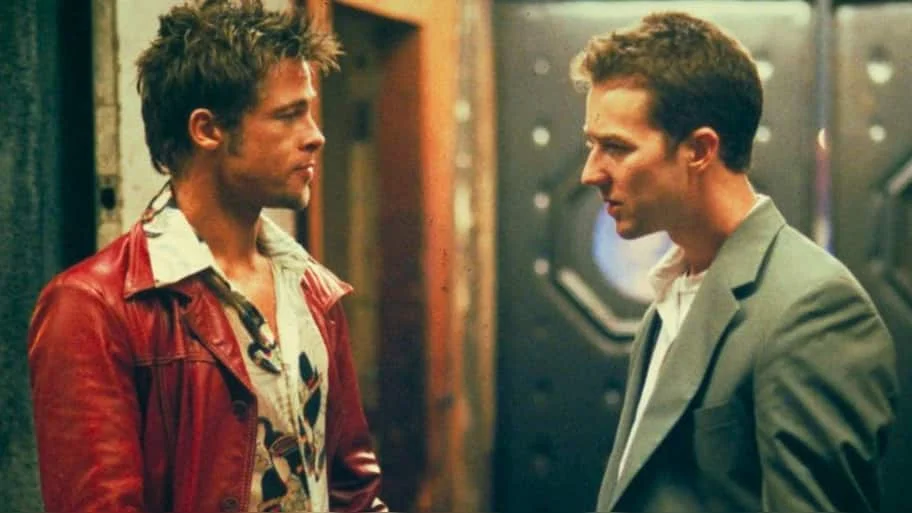
Dialogue of the Day: Some lines are meant to comfort you. This one is meant to provoke you. Tyler Durden isn’t offering reassurance here, he’s making an argument, one that challenges the entire foundation of how most people build their sense of security, through possessions, status, and the careful accumulation of things they’re terrified to lose.
Released in 1999 and directed by David Fincher, Fight Club follows an unnamed narrator whose disillusionment with consumerism and modern life leads him into an underground fight club, and eventually into the orbit of the volatile, magnetic Tyler Durden. Starring Edward Norton and Brad Pitt, the film became a cultural phenomenon for its unflinching critique of materialism and identity, and lines like this one continue to circulate decades later, still sparking debate over how much of Tyler’s philosophy is dangerous, and how much of it is simply an uncomfortable truth most people would rather not examine too closely.
Because they have too much to lose, most people don’t take risks, don’t change direction, don’t walk away from things that no longer serve them,. There’s nothing left to lose, which means, for the first time, there’s nothing stopping you from doing absolutely anything.
What’s actually being said here? On its surface, the line sounds almost nihilistic, an invitation to stop caring about anything at all. But underneath that provocation is a sharper observation about what actually holds people back from living differently. Jobs, possessions, reputations, comfort, all of it becomes a kind of quiet cage, one that feels like safety but often just keeps people stuck exactly where they are. Tyler’s argument is that the moment all of that disappears, when there’s genuinely nothing left to protect, something strange happens. The fear that used to dictate every decision suddenly has nothing left to hold onto. It’s a brutal kind of freedom, the kind nobody would choose voluntarily, but the film argues it’s real freedom nonetheless. Of course, the film doesn’t present this idea as pure wisdom either, Tyler Durden is far from a stable or trustworthy narrator, and the movie is deeply critical of where this philosophy eventually leads. But the line itself, stripped away from the character delivering it, still lands as an uncomfortable truth worth sitting with. Attachment to what we have is often exactly what keeps us from becoming who we could be. Maybe that’s why this line still gets quoted so often, well outside the context of the film’s darker themes. It’s not really advice to burn your life down. It’s a blunt reminder that the things we’re most afraid to lose are often the very things quietly keeping us small.
